
Digital Privacy in Europe in 2026: Citizen Protection or a New Era of Surveillance?
Chat Control, eIDAS 2.0 and the new challenges facing digital privacy in Europe in 2026. What is changing, and how you can actually protect your privacy.
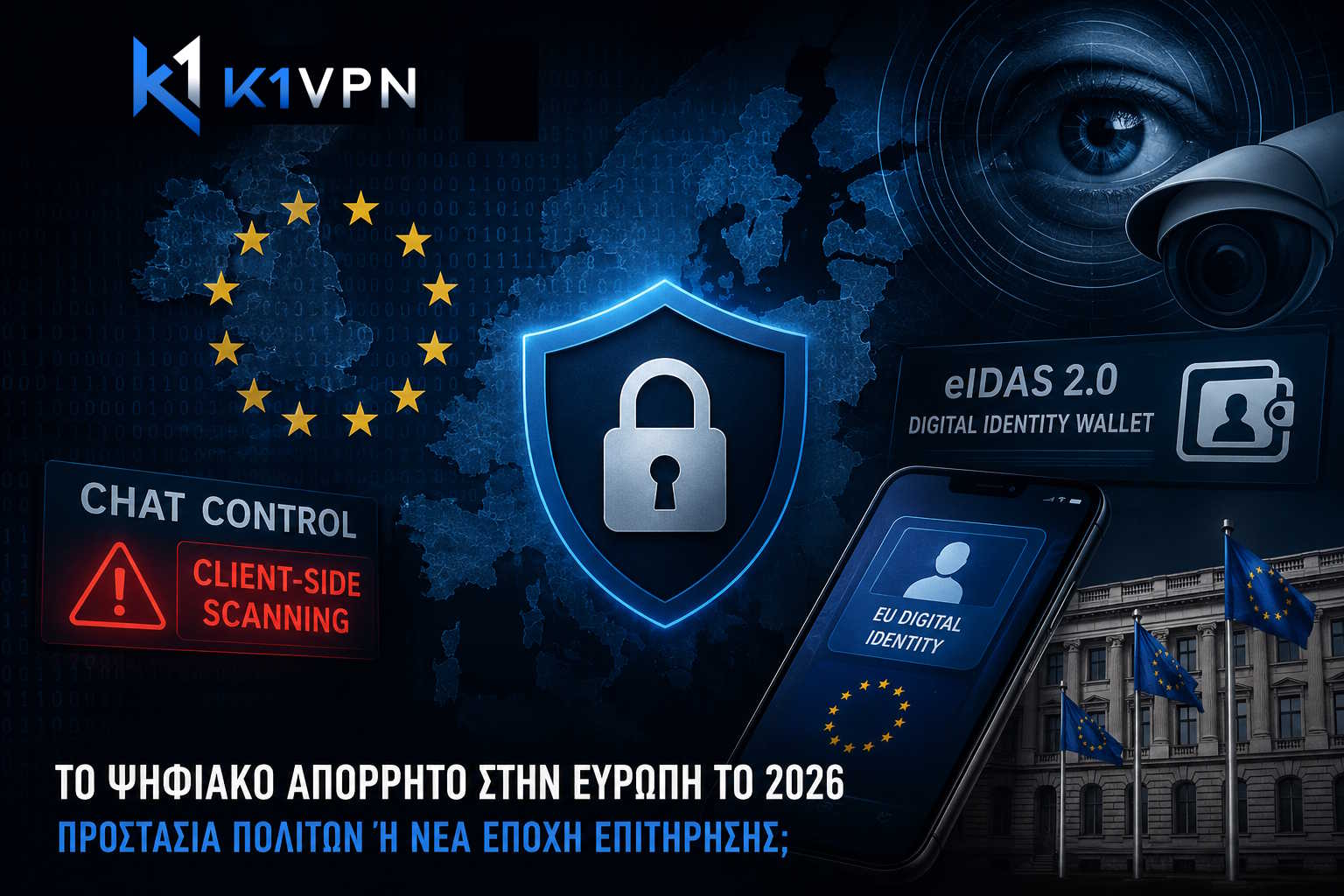
The GDPR changed the rules
The European Union has tied its name to data protection and privacy more than almost any other international body. The adoption of the General Data Protection Regulation (GDPR) in 2018 became a global benchmark, setting a new standard of transparency and accountability for businesses and public institutions alike.
The GDPR sent a clear message: personal data belongs to citizens, not to companies or states. For years, Europe was seen as the strongest defender of digital privacy against mass data collection by tech giants and against the steadily growing capabilities of surveillance.
How Chat Control was born
In recent years, though, the conversation has shifted significantly.
The rapid rise in online crime, the spread of Child Sexual Abuse Material (CSAM), cyberattacks, terrorism and organized crime have put intense pressure on governments to find more effective tools for preventing and detecting criminal activity.
Out of this environment came one of the most controversial legislative initiatives of the past decade: the proposed Regulation on Preventing and Combating Child Sexual Abuse (Child Sexual Abuse Regulation - CSAR), now widely known as Chat Control.
Public debate around this regulation is often polarized.
On one side are those who believe protecting children requires new technological tools capable of detecting illegal content even within encrypted communication services.
On the other side are human rights organizations, cryptography researchers, cybersecurity experts and several European data protection bodies, who warn that some of the proposed solutions could set a precedent for mass surveillance of private communications.
The reality is far more complex than it is usually presented.
The question isn't whether children should be protected from online exploitation. On that, there is near-universal agreement.
The real question is whether this can be achieved without undermining fundamental rights such as private communication, strong encryption, and the security of the internet itself.
A bill that divided Europe
The European Commission presented its initial proposal for the Regulation in May 2022, aiming to create unified rules for detecting, reporting, and removing child sexual abuse material from online services.
According to the European Commission, the existing situation was inadequate. Service providers followed different practices, and in many cases there was no clear legal framework defining what actions were permitted and what were not.
The proposed Regulation aimed to create a single European system for tackling the problem.
However, it triggered strong reactions from the very first moment.
The core concern was never about the goal of protecting children, but about the means proposed to achieve it.
Many experts argued that certain provisions could lead to mass, indiscriminate scanning of private communications, even those protected by end-to-end encryption technologies.
The European Data Protection Board (EDPB) and the European Data Protection Supervisor (EDPS) had already, back in 2022, expressed serious reservations about the compatibility of certain measures with the fundamental rights enshrined in European law.
At the same time, dozens of academics, cryptography experts and digital rights organizations warned that the technical solutions under discussion could create new risks for both privacy and the security of information systems themselves.
Timeline of events
The journey of Chat Control so far has been anything but smooth.
May 2022. The European Commission officially presents its proposal for the new Regulation to combat online child sexual abuse (CSAR).
2023. The European Parliament makes significant amendments to the original proposal, placing particular emphasis on protecting strong encryption and limiting some of the most controversial provisions.
2024 - 2025. Member states struggle to reach a common position. Several scheduled votes are postponed, while the Council of the European Union repeatedly works on compromise proposals.
26 March 2026. The European Parliament rejects an extension of the temporary voluntary content-scanning regime, informally known as "Chat Control 1.0."
3 April 2026. The temporary regime expires, creating a transitional legal gap until a permanent framework is agreed.
June - July 2026. Negotiations continue between the European Commission, the European Parliament and the Council of the European Union, with no final political agreement reached so far.
The fact that, four years after the original proposal, such deep disagreements still remain shows just how difficult it is to strike a balance between protecting society and safeguarding citizens' fundamental rights.
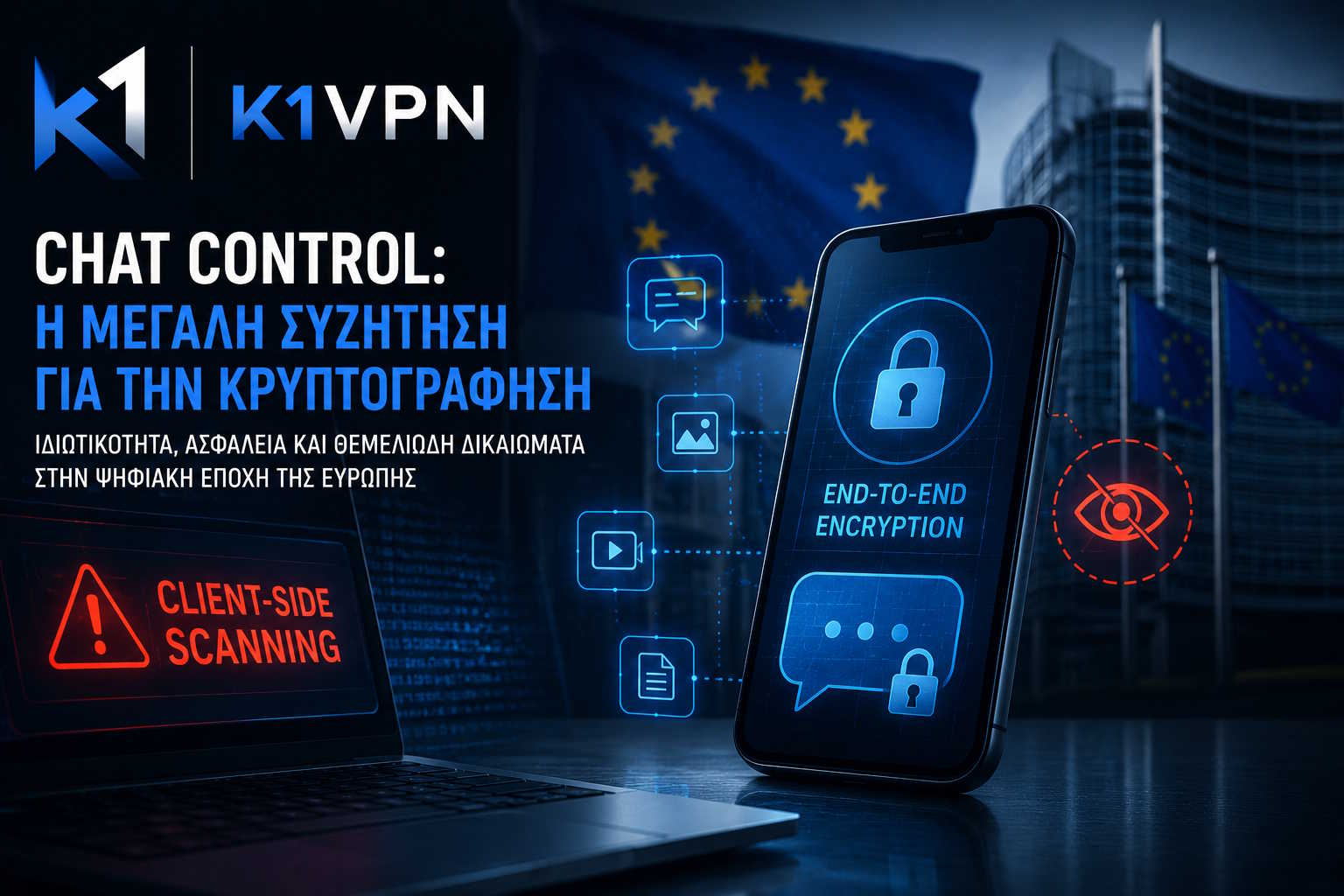
Why this debate isn't just about technology
One of the biggest mistakes in the public conversation is treating Chat Control as a purely technical issue.
In reality, it's primarily an institutional and legal question.
Should private electronic communications remain private by default, with any interference allowed only after a specific judicial order?
Or can a technical infrastructure be built that enables automated content detection on a much broader scale, as long as it's justified by an important social purpose?
The answer to that question isn't just about today's legislation.
It's about how digital Europe will be shaped over the next decade.
That's why this particular proposal has sparked reactions that go far beyond the cybersecurity world.
Lawyers, constitutional scholars, academics, human rights organizations, technical experts, software developers and companies building encrypted communication services are all now part of the conversation.
There isn't just one point of view
It would be wrong to frame the debate as a fight between "good guys" and "bad guys."
Supporters of the Regulation make arguments that can't be ignored.
They point out that online child sexual abuse is a real and constantly growing problem, that criminal organizations increasingly rely on encrypted communication services, and that law enforcement needs more effective tools to identify both perpetrators and victims.
On the other side, critics of the proposal point out that building technological mechanisms for mass detection could have far broader consequences than the purpose they were originally designed for.
What is applied exclusively today to combat child exploitation could, theoretically, be used in the future for entirely different purposes, if a future legislative decision allowed it.
Experts call this phenomenon function creep - the gradual expansion of a technological infrastructure beyond the original purpose for which it was built.
This concern isn't theoretical. It's one of the main reasons this particular piece of legislation keeps triggering such strong reactions across Europe.
Client-Side Scanning: The biggest technical fight over encryption
The most important point of contention around Chat Control isn't whether online child sexual abuse should be tackled. Almost no one disagrees with that goal.
The real disagreement is about how it can be achieved.
At the center of the debate is a technology known as Client-Side Scanning (CSS).
To understand why this technology has triggered such strong reactions, we first need to look at how end-to-end encryption (E2EE) works today.
In a truly encrypted communication, a message is encrypted on the sender's device and only decrypted on the recipient's device.
Neither the service provider, nor the server administrator, nor any third party sitting on the network can read the content of the communication.
This is why apps like Signal, WhatsApp and other end-to-end encrypted services are considered among the safest forms of digital communication today.
Client-Side Scanning changes that logic.
Instead of trying to decrypt communication in transit, it shifts the inspection to the user's own device.
The software examines photos, files, videos or messages before they're encrypted and sent, or immediately after they're decrypted.
This way, encryption technically remains intact during data transfer.
But the content has already been inspected.
The "locked house" analogy
One of the easiest ways to understand the difference is to imagine a house with a completely secure, reinforced front door.
The door remains impossible to break in from outside.
But the owner is required to allow an inspector inside the house, who checks every item before it can leave through the door.
The door stays technically secure.
But privacy has already been lost.
This is exactly what many experts argue happens with Client-Side Scanning.
Encryption keeps working.
But the communication is inspected before it's even protected by it.
That's why several researchers believe this approach bypasses the core philosophy of end-to-end encryption, even if it doesn't mathematically "break" the underlying algorithms.
Reactions from the scientific community
Opposition to Client-Side Scanning doesn't come only from VPN companies or privacy advocacy groups.
In recent years, hundreds of experts in cryptography, information security and computer science have signed open letters warning that no technology currently exists that can perform generalized scanning of private communications without significant risks to security and fundamental rights.
Similar concerns have also been raised by the European Data Protection Board (EDPB) and the European Data Protection Supervisor (EDPS), who point out that certain elements of the proposal could create a disproportionate intrusion into citizens' private lives.
At the same time, organizations such as the Global Encryption Coalition, the Internet Society and European Digital Rights (EDRi) have repeatedly called for strong encryption to be protected as a core pillar of cybersecurity.
The problem of false positives
Even if we assume a scanning technology could work reliably in technical terms, a serious practical problem remains.
So-called false positives.
In simple terms, these are cases where a completely legitimate file or a normal conversation is wrongly flagged as suspicious.
No artificial intelligence technology is infallible.
Especially when trying to recognize new, unknown, or modified content.
However small the error rate, when applied to billions of photos and messages every year, it can generate a massive number of false reports.
This isn't just a data protection issue.
It's also an operational problem.
Law enforcement agencies could be forced to handle a huge volume of reports that ultimately have nothing to do with criminal activity, making it harder to identify actual offenders.
Notably, several experts have pointed out that the effectiveness of such systems depends not only on the technology itself, but also on data quality, how the algorithms are trained, and continuous human review of the results.
What supporters of Chat Control argue
To present a complete picture, the opposing view needs to be heard too.
Supporters of the proposal point out that:
- online child sexual abuse keeps increasing
- more and more criminal activity is moving to encrypted services
- companies already voluntarily use technologies to detect known illegal material
- Europe needs a unified legal framework instead of different rules in every member state
The European Commission also argues that any detection order should come with strict safeguards, judicial oversight and proportionality.
Critics, on the other hand, believe that even with such safeguards, building this kind of technological infrastructure creates something that could be used for much broader purposes in the future.
The "function creep" phenomenon
In information security, there's a term that comes up often: function creep.
It describes a situation where a technology is designed for one very specific purpose but gradually expands and ends up being used for far more functions than originally intended.
The history of technology offers plenty of examples of tools built for a limited use case that, over time, ended up applied far more broadly.
This is one of the main reasons several experts believe that building a generalized infrastructure for scanning private communications needs to be examined with extreme caution.
The question isn't just what's allowed today.
The question is what could be allowed in the future, using that same technological infrastructure.
Why the legislative process is taking so long
The answer is simple.
Because there's no easy solution.
From 2022 to today, the proposal has been amended many times.
The European Parliament, the European Commission and the Council of the European Union have taken different approaches on critical issues such as:
- protecting encryption
- the powers granted to service providers
- the procedures for issuing detection orders
- judicial oversight mechanisms
- the proportionality of the measures
The length of these negotiations reflects exactly how difficult it is to find a solution that protects children without, at the same time, creating serious risks to fundamental rights.
Where the debate stands today
As of July 2026, no final political agreement has been reached on the permanent CSAR framework.
Negotiations continue, and substantial disagreements remain between European institutions and member states over protecting encryption and the powers that should be granted to the relevant authorities.
The outcome of this process will affect not only technology companies but also hundreds of millions of European citizens who use private communication services every day.
Beyond Chat Control: New challenges for privacy in Europe
Public debate about digital privacy in Europe often focuses almost exclusively on Chat Control. However, it isn't the only legislative initiative shaping how European citizens will use the internet in the years ahead.
At the same time, major reforms are underway involving digital identity, electronic trust services, age verification, and the broader architecture of digital security across the European Union.
While these are separate pieces of legislation, they're all connected by a common thread: the effort to balance security with the protection of fundamental rights.
eIDAS 2.0 and the European digital identity
One of the European Union's most significant digital transformation projects is the revised eIDAS 2.0 regulation, which lays the groundwork for the European Digital Identity Wallet (EU Digital Identity Wallet).
Its goal is to let citizens prove their identity electronically, sign documents, use public services, and carry out electronic transactions in a unified way across all member states.
In theory, the benefits are significant. A citizen would be able to, for example:
- prove their identity without physical documents
- use public services in other member states
- sign contracts electronically
- store certificates, licenses and other official documents in a secure digital wallet
The European Commission has repeatedly stated that the system is designed on the principle of privacy by design, using technologies such as selective disclosure, so that users only share the exact data required for each transaction.
Why concerns are being raised
Although the goal of eIDAS 2.0 is different from that of Chat Control, several experts have raised concerns about how the European Digital Wallet could be used in the future.
These concerns aren't really about the technology of the Wallet itself, but about the possibility that its use could gradually expand.
For example, if major online services eventually decide to rely on the European digital identity for functions like age verification or access to certain services, anonymous use of the internet could become significantly more limited in specific contexts.
This doesn't mean eIDAS was built to eliminate anonymity.
It does mean that every new digital identification system requires careful attention to how it's actually implemented in practice.
The debate over age verification
A characteristic example is age verification.
In recent years, several European initiatives have sought to limit minors' access to harmful or inappropriate content.
This goal is widely accepted.
The technical implementation, however, is the subject of intense debate.
Many experts believe age verification should be done in a way that reveals only the strictly necessary information - for example, that someone is over 18 - without requiring disclosure of their full identity.
This is exactly why the European Commission has repeatedly referred to the use of technologies that minimize the personal data exchanged between services.
Whether this approach succeeds or fails will depend heavily on how it's implemented and on the technical specifications ultimately adopted.
The controversy over Article 45 of eIDAS
One of the most controversial parts of eIDAS 2.0 was Article 45, which concerns Qualified Web Authentication Certificates (QWACs).
This particular provision sparked strong reactions from organizations like the Mozilla Foundation and from experts involved in developing modern browsers.
The core concern was that certain provisions could limit the independence with which browsers manage the trust system for digital certificates.
In simple terms, critics feared that browser makers would lose part of their ability to make independent decisions about the trustworthiness of certain security certificates.
The European Commission, for its part, argued that the goal of eIDAS is to build a trustworthy European framework for digital identification, not to weaken internet security.
This debate once again highlighted just how difficult it is to design pan-European technical standards that satisfy governments, technology companies, security experts and rights organizations all at once.
The future of anonymity online
For more than two decades, browsing the internet largely relied on the principle that a user could visit websites without needing to prove their real identity at every step.
That trend now appears to be gradually shifting.
The rise in online fraud, disinformation, online abuse and cyberattacks is pushing more and more governments to look for stronger identification mechanisms.
The European Union is no exception.
The critical question isn't whether more forms of digital identification will be used.
The question is whether they'll be designed in a way that keeps control of personal data in the hands of the citizen.
Want privacy with no identification trail, not even in how you pay? Pay for your K1VPN subscription with Crypto (Bitcoin, USDT...) →
Privacy isn't the opposite of security
One of the most important takeaways from all these discussions is that privacy and security aren't opposing concepts.
In reality, strong encryption protects:
- citizens
- businesses
- hospitals
- public services
- banks
- critical infrastructure
The same technologies that protect a journalist or a lawyer also protect banking systems, electronic payments, and the everyday transactions of millions of citizens.
That's why the debate around encryption isn't just about privacy.
It's about the security of the modern digital world as a whole.
A turning point for Europe
The European Union is standing at a critical crossroads today.
On one side, there's a real need to more effectively tackle serious forms of crime.
On the other, there's an obligation to protect rights that form the foundation of every democratic society.
Whether Europe manages to strike a balance between these two goals will largely determine how European citizens communicate, work, and use the internet in the years ahead.
What you can actually do to protect your online privacy
Regardless of how the European negotiations ultimately play out, one conclusion is already clear: privacy protection can no longer be taken for granted.
Technology is evolving at unprecedented speed.
So are the capabilities for collecting, analyzing, and processing data.
Every time we use a browser, a messaging app, a social network, or even a simple browsing service, a massive amount of information is generated.
Some of it is necessary for the service to function.
Some is used for security purposes.
But a lot of it is used for statistical analysis, ad targeting, or building user profiles.
In this environment, privacy protection doesn't depend on a single tool.
It's the result of a combination of the right technology choices, responsible use, and staying informed.
The biggest myth about VPNs
VPNs have become especially popular in recent years.
Unfortunately, along with that popularity came a wave of exaggerated marketing promises.
It's common to see claims like:
- "Become completely invisible on the Internet."
- "Absolute anonymity."
- "100% protection from any tracking."
- "No one can see what you're doing."
The reality is more complicated.
A VPN can't make your digital identity disappear.
It can't protect you from every possible threat.
It can't cancel out every tracking technology used on the internet today.
That doesn't mean it isn't useful, though.
Quite the opposite.
Used correctly, it's one of the most important tools for protecting your privacy.
What a VPN actually protects
A modern VPN creates an encrypted "tunnel" between your device and the VPN server. This means:
- your local internet provider can't see in detail which websites you visit through the encrypted connection
- your real public IP address isn't exposed to the services you use
- it becomes significantly harder to build a profile based on your location or IP address
- using public Wi-Fi networks becomes much safer
- several forms of tracking that rely purely on network traffic are limited
For many users, this level of protection already matters a great deal. Especially when traveling, working remotely, or frequently using public wireless networks.
Want this level of protection for your own connection? See K1VPN subscription plans →
What a VPN can't do
It's just as important to understand the limits of this technology. A VPN can't:
- protect an account whose password has already been leaked
- prevent phishing attacks
- stop an app from collecting data you choose to give it yourself
- remove cookies or browser fingerprinting
- protect a device that's already infected with malware
- stop services you're logged into with your personal account from knowing who you are
- prevent technologies like Client-Side Scanning, when they're applied on the device before encryption happens
Knowing these limitations matters just as much as knowing a VPN's capabilities. Online security never relies on a single technology.
Privacy is a daily habit
Effectively protecting your digital life comes down to many small but meaningful choices. Some of the most important are:
Use strong, unique passwords. Reusing the same password across multiple services remains one of the most common causes of account breaches.
Enable multi-factor authentication (MFA). Even if a password leaks, a second layer of protection can prevent unauthorized access.
Keep your software up to date. Most attacks exploit known security gaps that were already fixed a long time ago.
Manage app permissions carefully. Before granting access to your microphone, camera, contacts, or location, it's worth asking whether it's actually necessary.
Use real end-to-end encryption wherever available. Strong encryption remains one of the most important tools for protecting private communication.
Use a trustworthy VPN. A VPN doesn't replace the measures above, but it works as a complement, adding one more layer of protection.
K1VPN's philosophy
At K1VPN, we believe trust is earned through transparency, not exaggerated promises.
That's why we never claim a VPN can solve every security problem or offer absolute anonymity.
What it can offer is a meaningful extra layer of protection for your connection, limiting the exposure of your real IP address and protecting your communication from many of the risks present on modern networks.
Our philosophy rests on three simple principles:
Minimizing data collection. We only collect what's necessary for the service to function, and nothing more.
Transparency. We believe users have a right to know exactly what a VPN service can and can't offer.
Modern security standards. We use modern protocols and technologies aimed at protecting your connection, not creating false expectations.
Privacy isn't just for people who "have something to hide"
One of the most common arguments heard in this debate is: "I have nothing to hide."
But privacy doesn't exist to protect people breaking the law.
It exists to protect ordinary life.
- A doctor communicating with their patients.
- A lawyer discussing a case with their client.
- A journalist protecting their sources.
- A business exchanging confidential information.
- A family communicating privately.
The confidentiality of communications isn't a privilege.
It's a fundamental right, protected both by the Charter of Fundamental Rights of the European Union and by the European Convention on Human Rights.
Protecting this right doesn't conflict with the need to tackle crime.
The real challenge is finding a balance that allows law enforcement to do its job without building technological infrastructures that could disproportionately affect the rights of millions of law-abiding citizens.
Conclusion
The European Union is facing one of the most important debates of the digital age.
The decisions made in the coming years won't just affect large technology companies or communication service providers.
They will shape how hundreds of millions of Europeans communicate, work, transact, and exercise their fundamental rights in the digital world.
Protecting children, fighting organized crime, and strengthening cybersecurity are goals no one disputes.
The debate is about how to achieve those goals without undermining the very technologies that protect the privacy and security of all citizens.
In a world where data collection keeps increasing, staying informed, using technology responsibly, and choosing tools designed with transparency and privacy in mind are the best investment for the future.
Digital privacy isn't a luxury.
It's a fundamental right that deserves to be protected with the same seriousness as every other individual freedom.