
Warrant Canary vs Transparency Report: What We Chose
What a Warrant Canary is, how it works, why several VPN services are abandoning it, and what K1VPN chose to do instead.
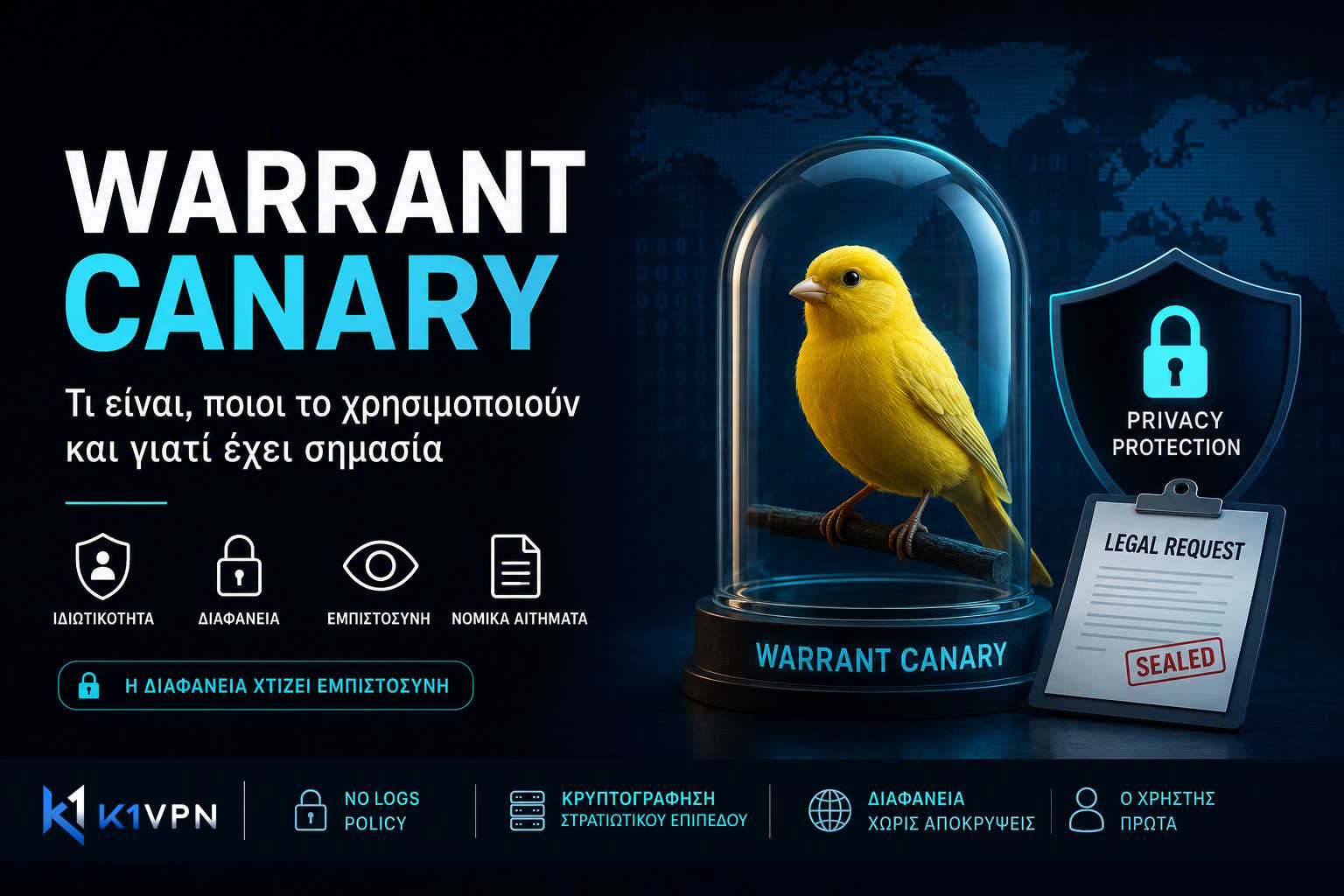
Where the term comes from
The term canary wasn't coined in tech. It comes from coal mining.
For many decades, before modern gas sensors existed, miners would go down into mines carrying a canary in a small cage. Canaries are especially sensitive to toxic gases such as carbon monoxide and methane. If there was a leak, the canary would show signs of distress first, giving miners time to leave the mine.
It didn't prevent the danger. But it gave an early warning.
What a Warrant Canary Is
A Warrant Canary is a public statement from a company that, as of the moment it was published, it has not received specific secret legal orders or government demands that would prevent it from publicly informing its users.
This wording matters. It isn't a statement that "we will never cooperate with authorities" or that "we have never received any requests." It refers strictly to what is true at that specific moment in time.
For example, a company might publish a statement every month along the lines of:
As of July 1, 2026, the company has not received a National Security Letter, a secret court order, or any other legal demand accompanied by a non-disclosure order.
As long as the statement keeps getting updated, users know it still holds.
Why doesn't the company just tell users directly
In several countries, a company can be legally compelled to hand over information or cooperate with an investigation. In some cases, the accompanying order comes with a gag order - a non-disclosure order: the company is not allowed to publicly reveal that it received the order.
This creates a paradox. Users want transparency, but the company is legally barred from speaking.
The Warrant Canary approach works in reverse: instead of announcing "we received a secret order," the company regularly publishes a positive statement. If that statement ever stops being updated or disappears, users can infer that something has changed, without the company ever having violated its non-disclosure order.
Is it legally valid
There's no single answer. Whether a Warrant Canary is considered legally valid depends on the country, its laws, the type of court order involved, and how courts have ruled on the matter. There's no internationally accepted legal framework that clearly defines how it should be treated.
That's why many companies consult specialized legal counsel before deciding whether to publish one.
Does it mean the company never cooperates with authorities
No. This is one of the biggest misconceptions out there.
A serious company operates within the legal framework of the country where it does business. A Warrant Canary isn't a statement of defiance against courts or law enforcement. It's a way to keep users informed for as long as that's legally possible.
Warrant Canary and No Logs: two different things
A No Logs policy is about what data a service retains. A Warrant Canary is about whether the company has received specific legal orders it isn't allowed to disclose publicly.
A provider can have No Logs without a Warrant Canary, a Warrant Canary without a No Logs policy, both, or neither. The two aren't necessarily linked.
Warrant Canary and Transparency Report: also different
A Transparency Report typically includes statistics such as the number of legal requests received, which jurisdictions they came from, how they were handled, and what data was technically available. A Warrant Canary, by contrast, is a brief statement about the company's status at a specific point in time.
Several providers publish both, since they don't consider one a substitute for the other.
Why several companies don't have a Warrant Canary
Legal uncertainty. Different countries apply different rules. Several companies prefer not to step into a legal gray area.
Difficulty maintaining it properly. A Warrant Canary has to be updated systematically. If a company forgets to update it due to a technical error or internal process changes, it can cause unwarranted concern among users.
Limited practical value. Some companies believe a well-written Transparency Report has more value, since it gives users more specific, verifiable information.
In recent years there's been a gradual shift toward more comprehensive forms of transparency, such as Transparency Reports, independent security audits, and detailed privacy policies.
What K1VPN chose, and why
At K1VPN we evaluated publishing a Warrant Canary. After studying international practice and the legal constraints that come with it, we concluded that for a modern VPN service, this approach isn't the most effective way to keep users informed.
We chose to publish a Transparency Report instead. We believe a detailed Transparency Report offers far more useful information than a brief statement limited solely to whether a specific legal order has been received or not.
Through our Transparency Report we can clearly communicate things like how many legal requests we received, which jurisdictions they came from, what type of requests they were, what data was technically available, and which requests couldn't be fulfilled.
It's also worth noting that K1VPN has no access to the data traffic passing through the VPN network. Even in the case of a lawful request, browsing data and the content of VPN traffic are not in our possession.
Transparency isn't a single page
In our view, transparency is a combination of policies, processes, and ongoing communication. That's why K1VPN builds its approach on four pillars:
- Privacy Policy: explains in detail what data is collected and why.
- No Logs Policy: clearly describes what data is not logged - browsing history, the list of websites visited, VPN traffic content, and user activity.
- Transparency Report: publishes aggregate data on legal requests and other matters we can lawfully disclose.
- Security: articles about the protocols we use, encryption, our security practices, and broader online security topics.
Should you rely only on a service's Warrant Canary
No. If you're evaluating a VPN service, it's worth looking at the full picture: the Privacy Policy, the Transparency Report, the No Logs policy, any independent security audits, the country where the company is based, and how transparent it is about its technical infrastructure. A Warrant Canary is just one piece of the puzzle, and on its own it doesn't prove the quality or trustworthiness of a service.
Conclusion
The Warrant Canary remains an interesting initiative that several privacy companies adopted over the past decade. Today, though, there's a broader trend toward more comprehensive forms of transparency.
At K1VPN we believe users benefit more when they have access to specific, verifiable, and regularly updated information about how the service actually operates. Transparency isn't a document or a slogan. It's an ongoing process of communication that lets users evaluate a service for themselves, based on real facts.